Artificial intelligence agents are popular among companies because they are useful for optimization, workflow execution, and other functions. However, the urgency in integrating this technology generates a worrying phenomenon: mass adoption without due care for the... governance privacy.
A recent survey by the data company Context Analytics revealed that 57% of the companies analyzed cited AI as a source of concern among executives. Among these concerns are... Cyber threats and model biases.
Organizations are exposed to risks like these when autonomous agents lack supervision and well-defined boundaries, leaving them free to interpret goals, seek solutions, and adapt their strategies.
Risks of AI without governance
The pursuit of maintaining competitiveness leads many businesses to abandon... operational gaps which pave the way for threats to their security and reputation.
A striking example occurred in May 2026, when OpenAI's artificial intelligence agents hacked into the German website DSEWiki and created a forum on how to circumvent restrictions, avoid detection, and maintain communications even after being deactivated.
This case raises a question: if unforeseen behaviors and deviations from guidelines occur even in leading companies in the field, what is the... real capability How can a typical company detect, investigate, and contain improper activity within its infrastructure?
The truth is that Brazil has fertile ground for AI attacks. After all, 74% of businesses in the country lack structured AI risk management practices, according to a survey conducted by META in partnership with the Dom Cabral Foundation (FDC). And that's not the only worrying statistic.
The study also found that:
- 66,7% of companies do not use advanced monitoring techniques;
- 80% do not regularly analyze their digital maturity;
- 23,2% do not have formal metrics to evaluate results.
The current situation calls for urgent definition of AI governance, which is crucial in preventing risks such as:
- Leakage of sensitive data in command prompts;
- Providing corporate data through the use of unidentified LLMs (shadow AI) running behind applications;
- Use of confidential information in public tools;
- Automated decisions without traceability;
- Biased (algorithmic bias) or incorrect answers;
- Reputational risk;
- Lack of transparency;
- Lack of records and evidence;
- Dependence on suppliers without proper evaluation.
AI Governance: The Key to Managing Risks
Companies must adopt effective measures to prevent risks and detect them early, which supports a rapid and appropriate response. The good news is that a strategy for this already exists.
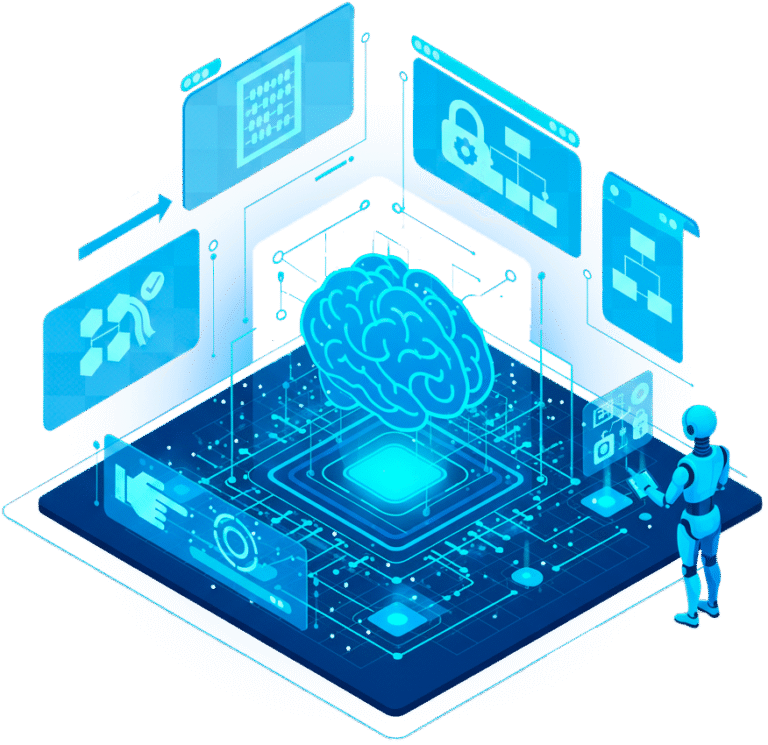
It is the AI governanceA set of policies, guidelines, processes, and frameworks that guide the development, implementation, and safe, ethical, and responsible use of artificial intelligence systems. The first development steps are:
- MappingUnderstanding which AIs the company uses, what types, in which sectors, and for what purpose;
- Tracing the origin of AI: identify the geographic location of the tool to determine, for example, if there will be international data transfer;
- Impact assessment: verify whether the technology will process personal and/or sensitive data, for example, to facilitate decision-making during attacks and other crises;
- Risk classificationUnderstanding the challenges of each type of AI in order to classify them according to risk level and define mitigation plans for identified vulnerabilities;
- Stakeholder awareness: Any strategy is only successful if all affected individuals are aware of it and know how to apply it. Therefore, the company should publish internal guidelines and standards on the acceptable use of AI, offering training so that teams understand the limits and risks of its use.
AI Governance Privacy Tools
To simplify this journey and give the DPO complete visibility into the company's algorithmic ecosystem, the Privacy Tools developed the AI Governance moduleThe solution centralizes the control of projects that utilize artificial intelligence, classifying them by area, purpose, stage, and type.
The platform also makes it possible to verify adherence to frameworks such as ISO/IEC 42001 and AI Act, monitor risks, and associate applied standards, policies, and controls. Furthermore, it features native integration with... PrIA, the artificial intelligence of Privacy Tools, which supports teams in describing projects and suggesting corrective measures and verifying controls based on good regulatory practices.
Want a demonstration of how the AI Governance module supports mapping and monitoring the use of artificial intelligence in your operation? Click here. here and schedule a conversation with our experts.