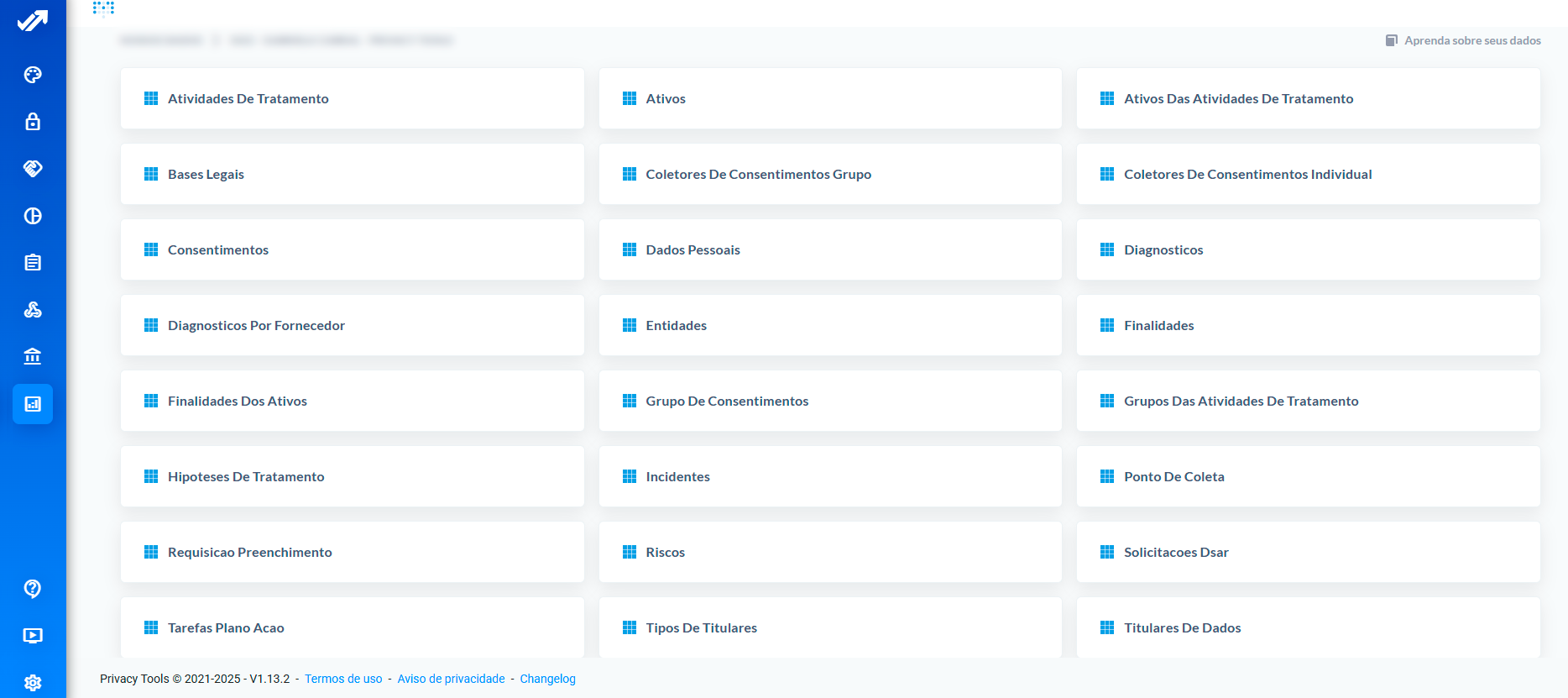
A Privacy Tools It supports concessionaires, generators, and distributors in structuring privacy governance in large-scale operations with millions of consumers and multiple units.
Energy companies process data from millions of consumers, including registrations, metering, billing, customer service, and digital channels, often using legacy systems and dozens of suppliers. Public and mixed-economy companies are further bound by the Access to Information Law, bidding processes, and controls from oversight bodies.
A Privacy Tools This scenario is supported by mapping processing activities by area and unit, discovering personal data in systems, providing centralized service to data subjects, managing incidents and third parties, and generating evidence for audits and regulatory bodies.
Energy, water, gas, and sanitation companies process data from millions of consumers through registrations, metering, billing, collections, customer service, ombudsman services, and digital channels, in addition to data from employees, contractors, and suppliers. LGPD It requires a legal basis for each activity (articles 7 and 11), with emphasis on contract execution and compliance with legal or regulatory obligations, transparency (article 9), respect for rights (article 18), and a governance program (article 50). Public companies and mixed-economy companies also follow the rules of treatment by the Public Authorities (articles 23 to 30) and the ANPD guidelines for the Public SectorANEEL and state agencies impose rules for customer service and consumption data, and the Access to Information Law coexists with the LGPD (Brazilian General Data Protection Law).
Consumer data in outdated systems without inventory; contractors and call centers with customer spreadsheets; self-service portals without a rights channel; sharing with agencies and partners without a documented basis; and privacy programs that exist on paper, without evidence for the board and regulatory bodies.
A Copel[Company Name], the largest company in Paraná, with 5 million customers and 200 km of network infrastructure, implemented a governance program in accordance with Article 50 of the LGPD (Brazilian General Data Protection Law) and made the Privacy Portal available on its website. Eletrobras GroupTogether with Eletrosul, Chesf, and Eletronorte, it centralized and automated the management of the program, with "a more detailed mapping of treatment activities and robust incident management."
Yes, and with additional rules: the chapter on data processing by Public Authorities (articles 23 to 30), the guidelines of the ANPD (National Data Protection Authority), and compliance with the Access to Information Law. The platform records the specific legal basis for each activity.
With a single channel (Privacy Portal), automatic authentication, workflows by type of right, and Data Discovery, automatic location of the applicant's data. Copel uses this model on its website.
Yes. The entity that processes consumer data on behalf of the concessionaire is a data processor: it must be evaluated, have an appropriate contract, and be included in the ROPA (Return on Application Processing Agreement) sharing agreement. Third-Party Risk Management structures this evaluation.
Yes, when linked to an identifiable consumer unit. They require a defined purpose, minimization and security, and must be included in the mapping as a specific activity.
Mapping by unit and consolidating in ROPA and Business Intelligence dashboards, as the Eletrobras Group did with Eletrosul, Chesf, and Eletronorte.
Request a demo from our team and see the platform in the context of your energy operation.