Incident Management
Incident Management is the module of Privacy Tools which records security incidents involving personal data, assesses the impact, and organizes communication with the ANPD (National Data Protection Authority) and data subjects.
Organize, respond to, and document incident handling with traceability, speed, and compliance with privacy regulations.
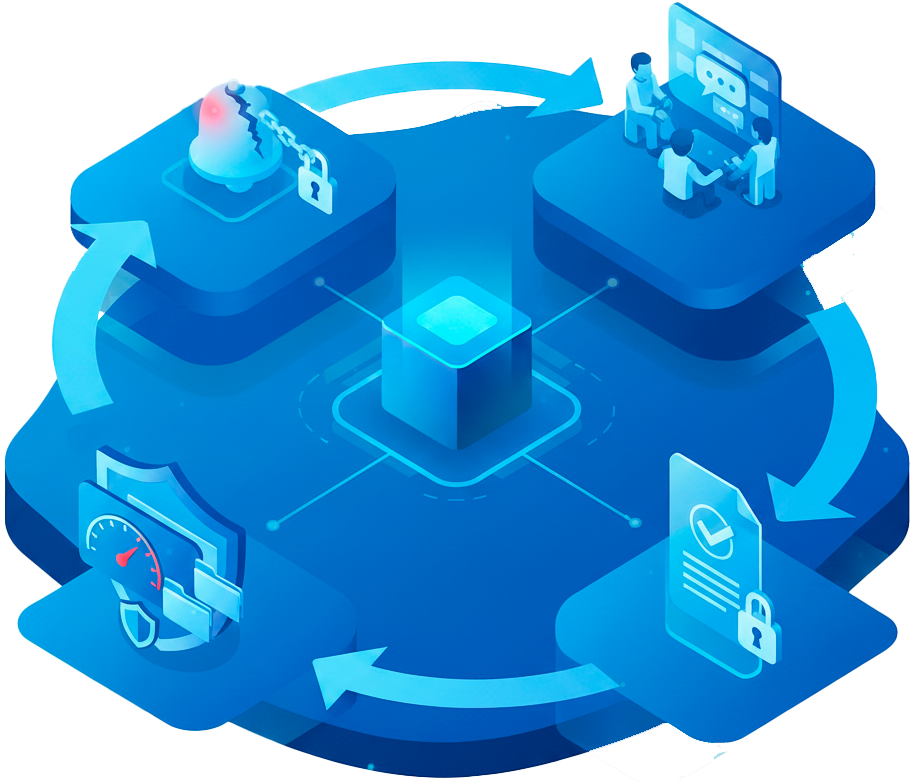
An incident doesn't have to turn into a crisis.
Mistakes happen. What defines the maturity of your operation is how you respond to them, and whether you can prove what was done, by whom, and when.
The module Incident Management da Privacy Tools This process is structured to offer a secure and traceable environment for recording, monitoring, and acting upon personal data breaches, with clear workflows and auditable evidence.
From identification to response:
Traceability and control at every stage.
Key features
Explore the features that make this solution complete, practical, and efficient.

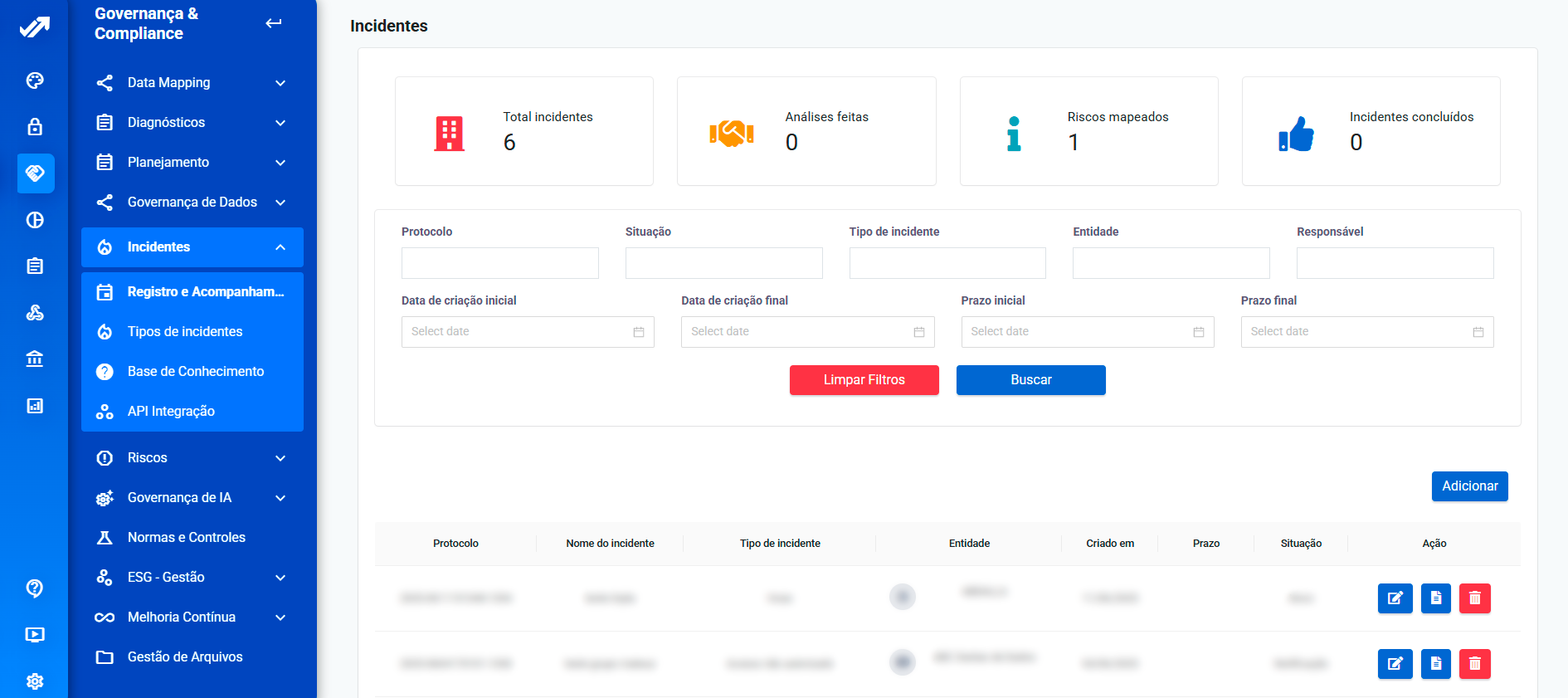
Structured incident log
Create records with custom fields for origin, type, impact, affected data, and responsible parties, with automatic protocol generation.
Identification of affected personal data
Map out which data was impacted by a breach, how it is used, where it is stored, and who has access to it, facilitating investigation and communication with data subjects and authorities.
Timeline and history of negotiations
Visualize all actions taken during incident management — including dates, assigned personnel, tasks, deadlines, and attached files.
Control panel with status and gravity information.
Track incidents on a central dashboard, with customizable risk indicators, resolution status, and severity levels.
Generating notifications for data subjects and the ANPD (Brazilian National Data Protection Authority).
Create complete or partial communications based on the recorded data, ready for submission to the ANPD (Brazilian National Data Protection Authority) or interested parties.
Audit and accountability reports
Export timelines, evidence, and results of actions for use in internal inspections or reviews.
Discover the Benefits
- Meet the requirements of the LGPD (Brazilian General Data Protection Law) with clarity and defined deadlines.
- Centralize records, evidence, and procedures in one place.
- Gain agility to respond to new incidents with ready-made processes.
- Integrate risk management into the governance program.
- Enhance the transparency of your operations with stakeholders, authorities, and clients.
With the BI of Privacy ToolsYou transform incidents into intelligence.
Track metrics such as response time, violation types, and critical points.

Who is Incident Management for?
This module is suitable for any organization that handles personal data and needs to respond to a breach methodically: hospitals and health insurance providers, financial institutions, retailers, media groups, dealerships, universities, technology companies, and public agencies. It is used by the Data Protection Officer (DPO), information security teams, legal departments, and the business areas involved in each case, and serves both large-scale incidents and small operational failures that, without documentation, would go unreported.
What the law requires and how the module complies.
Article 48 of LGPD This obligates the controller to notify the ANPD (National Data Protection Authority) and the data subject of any incident that may pose a significant risk or harm, describing the data affected, the data subjects involved, the security measures, the risks, and the actions taken. CD/ANPD Resolution No. 15/2024 It sets a deadline of three business days for reporting and requires internal logging of all incidents, including those not reported. GDPR (Articles 33 and 34) require notification within 72 hours.
- Internal record of all incidents: The structured record creates the protocol with origin, type, impact, affected data, and responsible parties.
- Description of the data and data subjects: The identification of affected personal data maps what was impacted, where it was located, and who had access to it, with support from... Data Mapping and Data discovery.
- Communication deadline: The generation of notifications for data subjects and the ANPD produces the documents with the required data, including the preliminary and complete communication.
- Measures and evidence: The timeline records each action with date, responsible party, attachments, and deadlines; the reports serve for auditing and accountability purposes.
- Managerial perspective: The control panel displays the status and severity of all open cases.
How to implement in five steps
- Response plan. Define incident categories, severity criteria, who decides on communication, and internal deadlines.
- Flows. Configure the treatment phases with assigned responsibilities, deadlines, and action plans based on severity, using the Workflow for automated tasks.
- Notification templates. Prepare the communication templates for the ANPD (National Data Protection Authority) and data subjects, including the fields required by the resolution.
- Training and simulation. Conduct an exercise with a fictional incident to test deadlines and roles.
- Continuous improvement. Use the Business Intelligence to measure response time, types of violations and critical points, and feed the Risk management.
Integrations and evidence
Incident Management interacts with Data Mapping (affected activities and systems), Data Discovery (data present in the breached environment), DSAR (data subject requests arising from the incident), Risk Management, and... Audits (Corrective actions). The timeline with attachments is evidence that the organization acted diligently, as required by Article 48 and the principle of accountability (Article 6, X, of the LGPD).
Results in case studies
Na EletrobrasThe DPO cites "robust incident and data flow management, reducing the risk of non-compliance." FIEMG The module was contracted along with consents, cookies, policies, Data Mapping, and DSAR. To understand the concept, see [link to relevant documentation]. What is a security incident? in the glossary.
Do you have any questions?
1. What types of incidents can I log in the module?
Any incident involving personal data: leaks, unauthorized access, unauthorized sharing, or operational failures.
2. Does the tool help with notifying the ANPD?
Yes. It is possible to generate documents and notifications with the data required by law, including partial responses (within 72 hours) and complete responses.
3. Can I track what has already been done?
Yes. The module maintains a timeline with all recorded actions, including responsible parties, dates, attachments, and deadlines.
4. The module can be integrated with other modules. Privacy Tools?
Yes. It complements the governance program and can work in conjunction with modules such as Audit, DSAR, and Data Discovery.
To compare the types of tools on the market, see the guide to... best tools for LGPD.
5. How quickly do I need to report an incident to the ANPD?
Within three business days of becoming aware that the incident may pose a significant risk or harm to data subjects, in accordance with Resolution CD/ANPD No. 15/2024. Under the GDPR, the deadline is 72 hours. The module generates the communication with the required fields and records when it was sent.
6. Do I need to report incidents that will not be reported?
Yes. The ANPD resolution requires internal logging of all incidents, whether reported or not, along with the assessment justifying the decision. The module's structured log fulfills this requirement and keeps the justification within the timeline.
7. How can I find out which data was affected?
Identifying the affected personal data cross-references the incident with Data Mapping (which activities and systems) and, when contracted, with Data Discovery (what data was in the environment), facilitating the description required in the communication.
8. Does the module help communicate with the data subjects?
Yes. In addition to communicating with the ANPD (National Data Protection Authority), it generates notifications to data subjects with appropriate language and fields, and subsequent support can be provided through the DSAR module.
9. How can you prove, months later, what was done in an incident?
Following the timeline: each action is recorded with the date, responsible party, deadline, and attachments, and the audit reports compile everything into a single document for accountability purposes.
Ensure clarity, agility, and traceability in incident response.
Request a demo and see how the Incident Management module of [company name] works. Privacy Tools It can strengthen its governance structure.