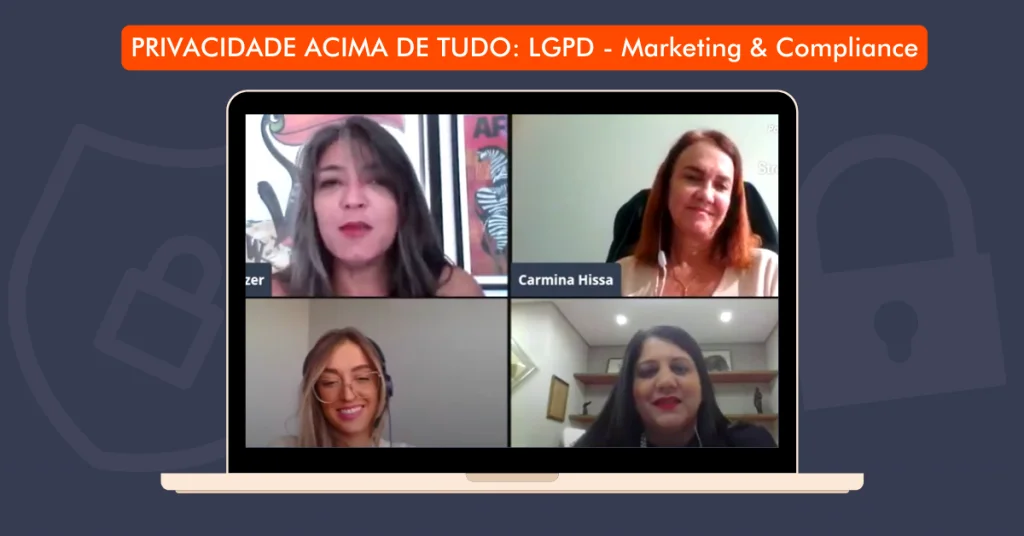
On March 9th, the day after International Women's Day, the Privacy Tools She held a free online event about Marketing and Compliance, with only female participants.
The chat, available for viewing on YouTube, featured:
- Daniela Mozer (Privacy Tools);
- Carmina Hissa (ABRASECI and Hissa & Galamba Lawyers);
- Fernanda Nones (Digital Results);
- Lidiane Leles (ANADD).
Here are some highlights from the discussion about personal data protection and the world of digital marketing:
The Relationship Between Law and Marketing
One of Fernanda Nones's statements, from RD, was that "when we stop to think, Law and Marketing, at first glance, seem like two worlds that are so disconnected.But they need to connect within a data protection context. We know that the law, however fast it advances, will never keep up with marketing and technology.”
Marketing professionals need to understand the legal basis they have for collecting personal data from users and customers. Therefore, a study of the law and a data mapping it's essential.
Several institutions rely on consent as the legal basis for collecting data for marketing purposes; however, according to Fernanda, "many companies that map their data and internal environment may discover that they don't need consent," as they have other justifications for processing information.
Dangers of buying personal data
Lidiane Leles, a specialist in Digital Law, says that it is necessary to "think about the principles that govern the LGPD (Brazilian General Data Protection Law), transparency, and the purpose of the data collected."
Lidiane emphasizes that when a consumer goes to a store and fills out a registration form, their wish is that their data not be shared, unless there is explicit authorization.
According to the expert, the purchase of personal information violates the principles of the LGPD (Brazilian General Data Protection Law). “In order to share data that has been authorized, you need to go back to that data subject and request it. There have already been cases of construction companies selling customer data to building materials stores. This violates the principles of the General Data Protection Law.”
Compliance with the LGPD (Brazilian General Data Protection Law) and its stakeholders.
In the legal field, the topic of the moment is the process of adapting to the General Data Protection Law (LGPD). Carmina Hissa, from ABRASECI and Hissa & Galamba Advogados, said during the event that it is important to define the roles of the controller and the operator. "In this, there is a very important thing, which is who is in charge." The controller will have the power to dictate the rules for how the data will be handled.The operator will comply with the controller's lawful orders.
Daniela Mozer, head of commercial partnerships at Privacy ToolsHe pointed out that the controller will want to see performance, and this is linked to the collection and processing of personal data for commercial purposes.
Data Transfers in Marketing
Regarding data transfer, Carmina says it depends on the company's "risk appetite." There are countries that still do not have federal data protection laws.
"If you transfer data to a country that doesn't have a federal law, you won't be in compliance with the LGPD," the lawyer warned.